After a strong earthquake
If you find it hard to stay on your feet or move objects normally
- Move away from the coast immediately, without waiting for instructions.
- Get to higher ground and head for the safe areas marked on the evacuation maps.


On Thursday 20 November 2025 a major tsunami drill, the Respuesta25 exercise, was held in the province of Cádiz, involving both the capital and several coastal municipalities. Its main aim was to test how emergency plans, public warning systems and coordination between authorities work in practice.
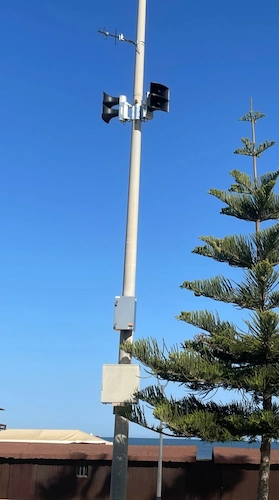
The exercise took place at a time when society is increasingly aware of the tsunami risk in Cádiz and of the importance of having reliable early warning systems. In municipalities such as Chipiona, this preparedness has already taken shape with the installation of long-range emergency sirens supplied by Lafcarr, fully integrated into the municipal civil protection plans.
The tsunami drill took place on the morning of 20 November 2025. According to information released by the Andalusian regional government and several town councils, the simulated warning was sent shortly after 10:00, as if it were a real tsunami alert on the Andalusian coast.
The city of Cádiz and all the coastal municipalities in the province took part, including:
Each municipality activated its local tsunami risk plan, with tailored exercises: drills in schools, deployment of emergency resources and coordination tests.
The main warning in the Cádiz tsunami drill came through ES-Alert, Spain's national public alert system, which uses Cell Broadcast technology to send emergency messages to every mobile phone connected to the masts in a given area.
In a drill:
To receive ES-Alert, all you need is to:
Chipiona has become a national benchmark for tsunami preparedness. It has a Local Tsunami Risk Action Plan approved by the Andalusian regional government and was the first municipality in Spain recognised as “Tsunami Ready” by UNESCO.
In the days before the Respuesta25 drill, Chipiona hosted technical workshops on local tsunami plans, attended by representatives of the 62 coastal municipalities of Andalusia.
A key part of tsunami preparedness on the Cádiz coast is the long-range electronic siren system supplied and integrated by Lafcarr. The sirens are installed at strategic points in Chipiona to cover highly exposed areas, both on weekdays and at peak tourist times.
Although it is a drill, the guidelines practised are the same as those that would apply in a real tsunami alert on the Cádiz coast. Remember these key steps:
If you find it hard to stay on your feet or move objects normally
ES-Alert on your phone, loudspeakers or radio/TV announcements
Behaviour that increases the risk
The Chipiona evacuation and safe-area maps, together with the guides from the Andalusian regional government and the IGN, explain the recommended routes in each municipality in detail. Checking them in advance is one of the best self-protection measures.
As well as the Chipiona siren system, Lafcarr has extensive experience in early warning solutions for tsunamis and coastal hazards:
Alongside its experience in early warning systems for floods, dams and technological hazards, Lafcarr offers turnkey solutions: design, in-house siren manufacturing, integration with control centres and communications, commissioning and maintenance.
At Lafcarr we design and integrate public warning systems with electronic sirens, redundant communications and our own emergency management software. More than 20 years working with public authorities back us up.
If you manage civil protection, critical infrastructure or coastal areas at risk, we can help you assess and deploy an early warning system tailored to your area.
It is a regional civil protection exercise that simulates a tsunami reaching the Cádiz coast. It is used to check how authorities, emergency services and public warning systems respond to a tsunami scenario.
In the Respuesta25 drill, the test message was sent at around 10:00 in the morning. Timings may vary slightly depending on how each exercise is organised, but it is always made clear that it is a drill with no real risk.
Yes. The system is designed to emit a very loud tone and vibration even if the phone is on silent, so that the warning is not missed.
Whether physical sirens are activated depends on each municipality's planning. In towns such as Chipiona, which already has an emergency siren system installed by Lafcarr, these tests can be part of the general drill or carried out in specific exercises announced in advance.
No. On the day of the drill, the message will state clearly that it is a test. You should only evacuate if your school, company or community has announced it as part of a supervised internal exercise.
Not necessarily. Sirens are placed at strategic points to cover areas where people gather most, such as beaches and seafronts. In many cases, the main channel for the general public will be the mobile phone message, backed up by radio, television and official social media.
After the exercise, check whether your phone was switched on, had signal and had emergency alerts turned on. It is also a good idea to follow the information published by your town council or civil protection services, which will explain how the test went and any issues detected.
Although the probability of a major tsunami is low, the potential impact would be very high. Drills help improve emergency plans, test warning systems and make sure people know what to do if the threat ever becomes real.
Lafcarr designs, manufactures and integrates public warning systems such as the electronic sirens installed in Chipiona, which are part of the town's local tsunami strategy. The company provides experience, technology and technical support so that drills and real emergencies can rely on dependable solutions adapted to each setting.
We design early warning and monitoring systems tailored to every environment. Tell us about your case.